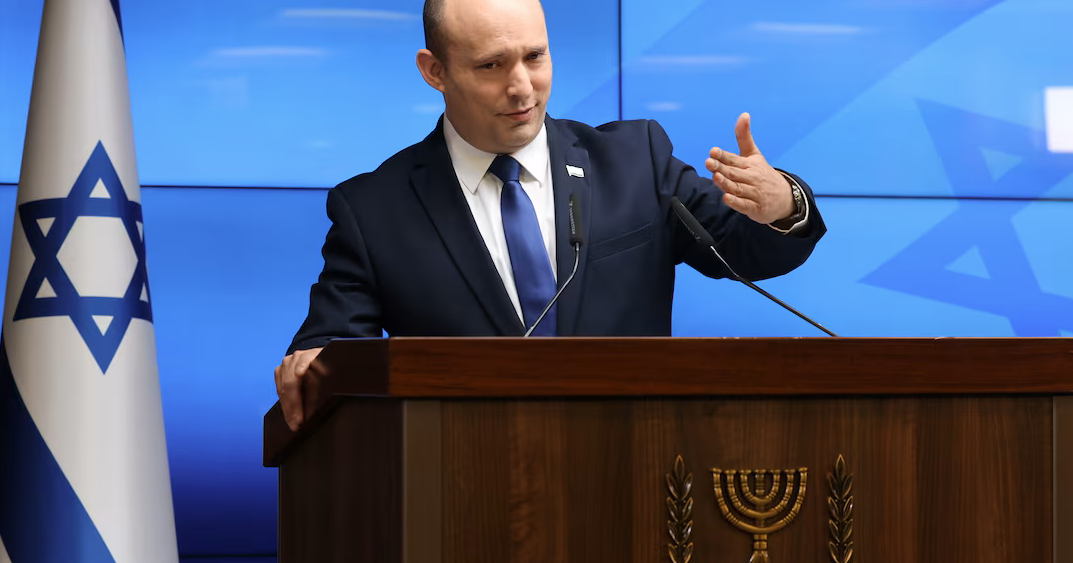

Former Israeli prime minister Naftali Bennett on Wednesday rejected a claim by an Iran-linked hacking group that it had infiltrated his mobile phone.
“Following tests that we conducted, it has been determined that Former Prime Minister Naftali Bennett’s phone wasn’t hacked,” Bennett’s office said in a statement on Wednesday.
Earlier in the day, the group, calling itself “Handala” and linked to Iran’s intelligence ministry, alleged it had hacked what it described as Bennett’s iPhone 13 as part of what it called “Operation Octopus.”
It went on to publish a link it said reveals a trove of private communications it extracted from his device.
The name appears to reference Bennett’s own long-standing description of Iran as “the head of the octopus,” with regional allied militant groups as its arms.
In an open letter, the group taunted Bennett, writing: “You once prided yourself on being a beacon of cybersecurity … Yet, how ironic that your own iPhone 13 has fallen so easily to the hands of Handala.”
“Consider this a warning and a lesson. If your personal device can be compromised so effortlessly, imagine the vulnerabilities that lurk within the systems you once claimed to protect,” the group added.
Handala published a series of files on its website and Telegram channel that it said were taken from the compromised device.
The group claimed it had gained access to private correspondence and contact information, publishing what it said were phone numbers linked to Bennett and to Avia Sassi, whom it described as a close associate.
Handala further claimed that the materials included private chats spanning several years, covering political coordination, candidate selection and, later, security-related concerns following the October 7 attack by Hamas militants on Israel.
Before the statement by Bennett’s office was released, Israel Hayom reported that Bennett’s office initially told the paper that it was "unaware of such an event." According to the report, Bennett’s security team said the matter is being handled by Israeli security and cyber authorities, that the device in question is not currently in use.
The report quoted Shai Nahum, a cyber warfare expert who reviewed the materials released by the group, said the data was unlikely to have originated from Bennett’s personal phone.
"According to forensic analysis of the leaked files, there is a high probability that this is not Bennett's phone, but apparently that of one of his associates," Nahum said.
Handala's claim comes a day after the group said it was offering a $30,000 reward for information related to Israel’s military sector after releasing material it said identified people involved in designing Israeli missile defense systems.
Who is Handala?
Handala is widely described by cybersecurity researchers and Western officials as tied to Iran’s Ministry of Intelligence.
It derives its name from a character created by Palestinian cartoonist Naji al-Ali. A barefoot boy in patched trousers, Handala represented Palestinian dispossession.
Researchers say the group operates as part of a broader cyber unit known as Banished Kitten, also referred to as Storm-0842 or Dune, which they link to the ministry’s Domestic Security Directorate.
The group has been linked to cyber operations against Israeli infrastructure and public institutions for around two years.
In January, it claimed responsibility for a cyberattack on Israeli kindergartens that disrupted public address systems at about 20 locations. In August, the group was linked to hacks targeting multiple Israeli entities, including academic institutions, technology firms, media outlets and industrial companies.
Handala has also been linked to cyber operations targeting Iran International, a London-based Persian-language broadcaster.
US President Donald Trump made Iran a final offer for a deal which Iran refused in June, the Washington Post reported on Wednesday citing officials, prompting his authorization of a plan to attack its nuclear program.
The Trump administration proposal to Iran dated June 15 demanded Tehran end support for armed allies in the region including Hamas and Hezbollah along with “replacing” the Fordow nuclear site and “any other functioning facility” with sites which do not allow uranium enrichment.
According to the text quoted by the Washington Post, the United States in return would lift “ALL sanctions placed on Iran."
Shortly after it was conveyed via Qatari mediators, the proposed deal was rejected by Tehran, and Washington authorized the attacks which would come the following month, the Post reported citing a senior diplomat involved in the process.
The United States held five rounds of negotiations with Iran over its disputed nuclear program earlier this year, for which Trump set a 60-day deadline.
Trump accused Iran of dragging out the talks while Tehran said Washington's demands were unreasonable and undermined their sovereignty.
When no agreement was reached by the 61st day on June 13, Israel launched a surprise military offensive followed by US strikes on June 22 targeting key nuclear facilities in Isfahan, Natanz and Fordow.
Trump said the attacks "obliterated" Iran's nuclear program, in an assertion disputed by Tehran, which denies seeking a nuclear weapons. Tehran has said war damage means no enrichment is ongoing but the standoff over its nuclear ambitions persists.
Israel is reassessing the impact of its June military campaign on Iran’s ballistic missile program as analysts say Tehran is keen to rebuild its core deterrent in a move that could set the stage for renewed war.
Iran’s ballistic missile stockpile appears largely intact following the June war, with roughly 2,000 heavy missiles still in its arsenal, according to Al-Monitor.
The outlet cited an Israeli security source saying that Israel's military intelligence had conveyed the assessment to the United States in an indication that Israel is urging Washington to again act to address the alleged threat.
A senior Israeli official told lawmakers in a closed Knesset briefing, according to Israeli outlet Ynet, that large-scale ballistic missile production has resumed roughly six months after the June war.
“Iran is taking steps to rebuild its missile production capabilities," Greg Brew, Iran analyst with the Eurasia Group think thank, told Iran International," which is not surprising given that it is imperative for the regime to strengthen its position following the war in June.”
Brew said rebuilding missile capacity is a more likely near-term goal than reviving the country's stricken nuclear program, which would carry significantly higher political and military risks.
Iran's Foreign Minister Abbas Araghchi said last month that Tehran had rebuilt its missile power beyond pre-war levels. Iran has also signaled its prowess publicly.
Last week, the Islamic Revolutionary Guard Corps announced major naval exercises in the Persian Gulf involving cruise and ballistic missiles with a reported range of 2,000 kilometers, as well as suicide drones.
The critical question, analysts say, is whether Iran’s rebuilding efforts will be tolerated.
“The real question is whether these steps will be enough to trigger action by Israel,” Brew said. “I’m inclined to think that Israel will act preemptively to prevent Iran from rebuilding a missile arsenal that could theoretically overwhelm Israeli air defenses.”
Such a move would almost certainly require American backing, Brew added.
While Israel’s campaign inflicted significant damage, analysts note it was always constrained in its ability to impose lasting limits on Iran’s missile program.
Farzin Nadimi, a senior fellow at the Washington Institute said Israeli strikes hit at least 15 of Iran’s 30 to 35 main missile industrial complexes and about 15 of 25 missile bases, with numerous mobile launchers also targeted.
But Iran’s hardened underground infrastructure blunted the long-term impact.
“Considering the industrial basis and hardened nature of IRGC missile tunnel complexes, it is almost beyond doubt that original Israeli estimates of sustainable damage caused to those facilities is over-optimistic,” Nadimi told Iran International, referring to the Islamic Revolutionary Guard Corps.
Israel and the United States expressed public satisfaction at the impact their joint war in June dealt to Iran, while Iranian officials have insisted their capabilities remain intact and have vowed retaliation for any future attacks.
For Shahram Kholdi, an expert on Middle Eastern military history, the reassessment reflects a recalibration of expectations rather than strategic failure.
“The June strikes were aimed at degrading and disrupting Iran’s missile program at a critical moment, not eliminating it outright,” he said.
As Israel and the United States reassess Iran’s missile trajectory, question may no longer whether Tehran is rebuilding, but whether its progress will cross red lines that prompt preemptive action — and whether Washington would support it.
The head of Israel's Mossad intelligence agency said Iran will seek to revive its nuclear program if given the chance but that Israel would thwart its ambitions to acquire a weapon.
“The idea of continuing to develop a nuclear bomb still beats in their hearts. We bear responsibility to ensure that the nuclear project, which has been gravely damaged, in close cooperation with the Americans, will never be activated,” David Barnea said at an award ceremony for agents in Jerusalem late on Tuesday.
Iran denies seeking a nuclear bomb but Israel along with the United States and Western countries doubt its intentions.
Israel launched a surprise military campaign on Iran in June which was capped off with US strikes on the country's main nuclear sites.
The conflict came after two months of negotiations which failed to win Iranian agreement to a US demand that it end domestic uranium enrichment.
Israeli attacks killed Iranian nuclear scientists as well as hundreds of military personnel and civilians. Iranian counterattacks killed 32 Israeli civilians and an off-duty soldier.
Despite the military setbacks to Tehran, it insists enrichment is its right and called Israeli and US actions aggression which aimed at its sovereignty and progress.
“The ayatollahs’ regime woke up in a moment to discover that Iran is exposed and thoroughly penetrated, yet Iran has not given up its aspiration to destroy the State of Israel,” Barnea continued.
“Iran believes it can deceive the world again and realize another bad nuclear agreement,” he continued. "We did not and will not allow a bad deal to come to fruition.”
US President Donald Trump said his June 22 attacks had "obliterated" Iran's nuclear program and that any attempt at rebuilding will trigger renewed US strikes.
Iran has rejected US demands that it end enrichment, curb its missile program and rein in support for armed allies in the region, leaving diplomacy at a stalemate.
Iran and Russia signed a cooperation document between their foreign ministries on Wednesday after talks in Moscow, setting out a consultations program for the years 2026 to 2028.
The document was signed by Iranian Foreign Minister Abbas Araghchi and Russian Foreign Minister Sergey Lavrov at the end of their negotiations.
Lavrov said the consultations plan was drawn up following the entry into force of a comprehensive strategic partnership treaty between the two countries earlier this year.
“Without any doubt, the main and key document in our relations is the comprehensive strategic partnership treaty between the Russian Federation and the Islamic Republic of Iran, which was signed this year and has entered into force,” Lavrov offering no details on the consultations agreement.
He said the treaty formally set out the special nature of bilateral relations and established key areas of cooperation and a long-term, 20-year outlook.
'Treaty deepens long-term cooperation'
The comprehensive strategic partnership treaty, signed in January by Russian President Vladimir Putin and Iranian President Masoud Pezeshkian and ratified by both countries’ parliaments, commits Moscow and Tehran to closer cooperation across political, economic, security and technological fields.
While it does not include a mutual defense clause, the agreement provides for expanded military-technical cooperation, coordination on security issues, closer economic ties and efforts to reduce the impact of Western sanctions, including through financial and trade mechanisms outside the dollar system.
Lavrov said the signing of the 2026-28 consultations plan marked a first in the history of ties between the two countries.
“Today, for the first time in history, we are signing a consultations program between the foreign ministries of Russia and Iran for the years 2026 to 2028,” he said, adding that dialogue between the two ministries was regular and highly valuable.
Broader coordination under sanctions
Both countries have stepped up coordination as they face extensive Western sanctions. They cooperate in forums such as BRICS, the Shanghai Cooperation Organization and the Eurasian Economic Union, and have expanded ties in energy, transport, trade, technology and space.
Iran and Russia say the strategic partnership treaty and the newly signed consultations plan provide a structured roadmap for advancing those ties over the coming decades.
A film by dissident Iranian director Jafar Panahi has advanced to the shortlist for the international feature film category at the 98th Academy Awards, organizers said on Tuesday.
Panahi’s film, It Was Just an Accident, was included among 15 shortlisted titles as France’s official submission. Films from 86 countries were eligible in the category, with Academy members required to view all shortlisted entries to take part in the nominations round.
The film was made secretly inside Iran and follows the moral dilemma of a group of former political prisoners who believe they have captured the man who once tortured them. The work draws directly on Panahi’s own experiences of detention and surveillance.
It Was Just an Accident won the Palme d’Or at the Cannes Film Festival earlier this year, further cementing Panahi’s standing as one of Iran’s most internationally recognized filmmakers despite long-standing restrictions on his work.
Legal pressure at home
Earlier this month, Panahi’s lawyer said the director had been sentenced in absentia to one year in prison on a charge of propaganda against the state. The ruling also included a two-year travel ban and restrictions on political and social activity. The sentence was issued while Panahi was abroad promoting the film.
Panahi has said he plans to return to Iran after completing the awards campaign, despite the risks. “I have only one passport, the passport of my country,” he said earlier this month.
Oscar nominations will be announced on Jan. 22, 2026. The awards ceremony is scheduled for March 15 in Los Angeles.
To shop authentic smartphones, accessories, and power solutions, visit Thikra Store.








Leave a Comment